Making life possible for communities in Bristol
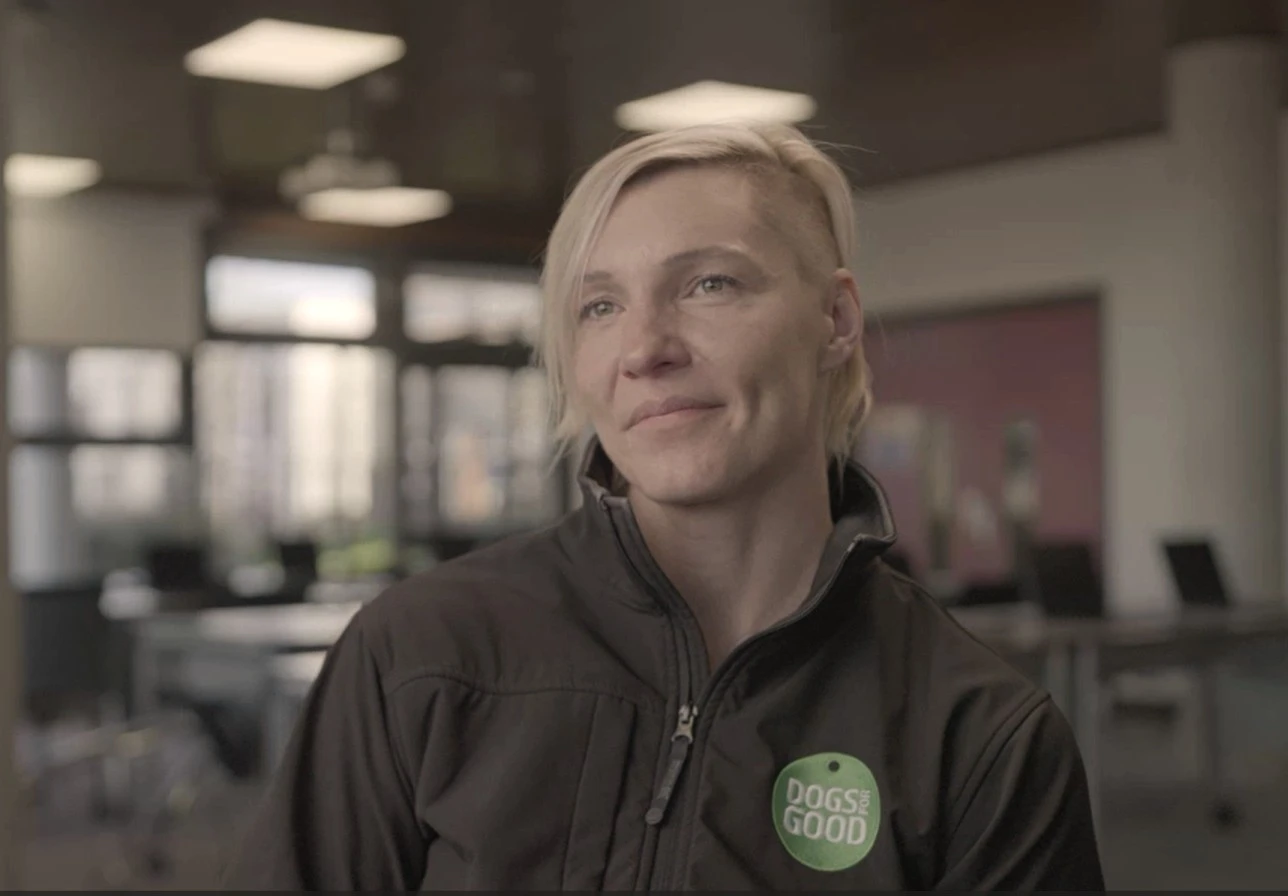
Julia and Georgie
15/12/2025
Julia and Georgie
15/12/2025
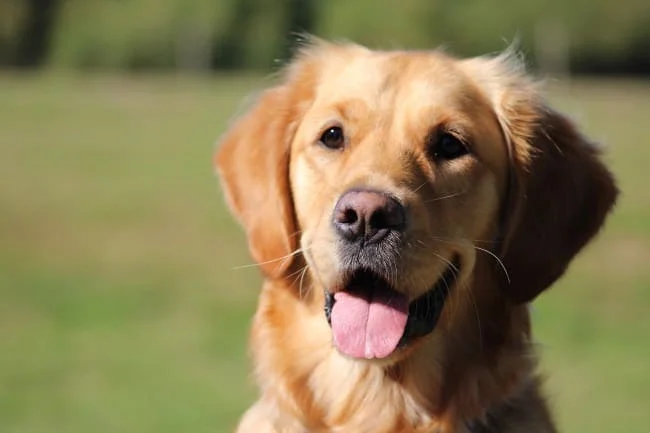
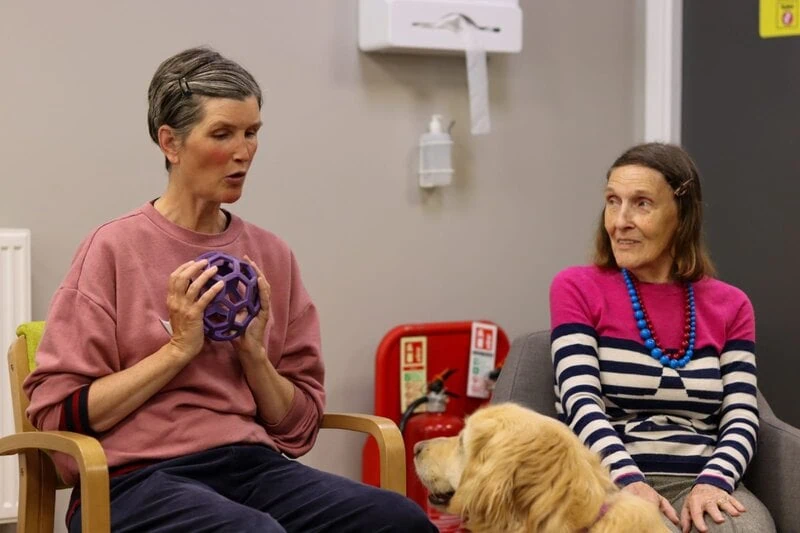
Recently, Community Dog Handler Julia and golden retriever, Georgie have been out and about in Bristol, supporting people in the community with a variety of different physical and emotional support needs.
One of the places they've been working is a secondary school, where Julia and Georgie deliver sessions to students who are dealing with grief and loss. And the impact of this work has led to some powerful outcomes.
Assistant head teacher, Hannah Green shared some insight into what she feels Dogs for Good brings to the school and its students.
"Honestly, I can’t brag enough about Dogs for Good. The collaboration between the charity and Merchant's Academy has been powerful. I have so much trust in them as an organisation; they have upstanding values, they put 110 per cent into the sessions and importantly, keep our young people at the centre of everything.
"When talking about emotional trauma, we know that play is really important. Play makes every part of our brain light up and delivers a pathway to right brain – the part that deals with emotions – healing. And where you’re looking at developmental gaps, the playful aspect to what Georgie brings is really important.
"Whether the students are playing hide and seek in the library with Georgie or they're all running around together in the field, they're engaging in a collaborative, playful activity which is also focused and fluid, to further develop healing.
"This then allows organic conversation about the hard things they're experiencing to take place, which in turn, brings about processing and further recovery.
"It's amazing to see these children, who have been navigating really hard and tricky stuff, feel safe and confident enough to open up.
"It is a gift and a joy to work with a charity that's passionate about everything that we're passionate about."
It's amazing to see these children, who have been navigating really hard and tricky stuff, feel safe and confident enough to open up.
One memory will, Hannah says, stick with her forever.
"We did a session with one of our students who was facing his first Mother's Day without his mum. It was planned and structured but the adults in the room were naturally, a bit nervous and apprehensive about what was going to be a tough session, talking about hard things.
"We get to a point, where he's walking through what his day had been like and he's very vulnerable, opening up and it's really powerful. You could tell that the tone had shifted in the room.
"Georgie was on the other side of the room, getting a drink of water and she completely picked up on how things had shifted. She walked over to him and laid her head on his lap. She could tell he needed that reassurance. He needed that comfort.
"I will forever remember that moment because it's tapping into that connection, that human-dog bond. And he was then able to finish talking about his day and talking about his mum because Georgie was comforting him.
"To me, that's the power of the work that Dogs for Good does and you can't trade that for anything."
Whether the students are playing hide and seek in the library with Georgie or they're all running around together in the field, they're engaging in a collaborative, playful activity which is also focused and fluid, to further develop healing.
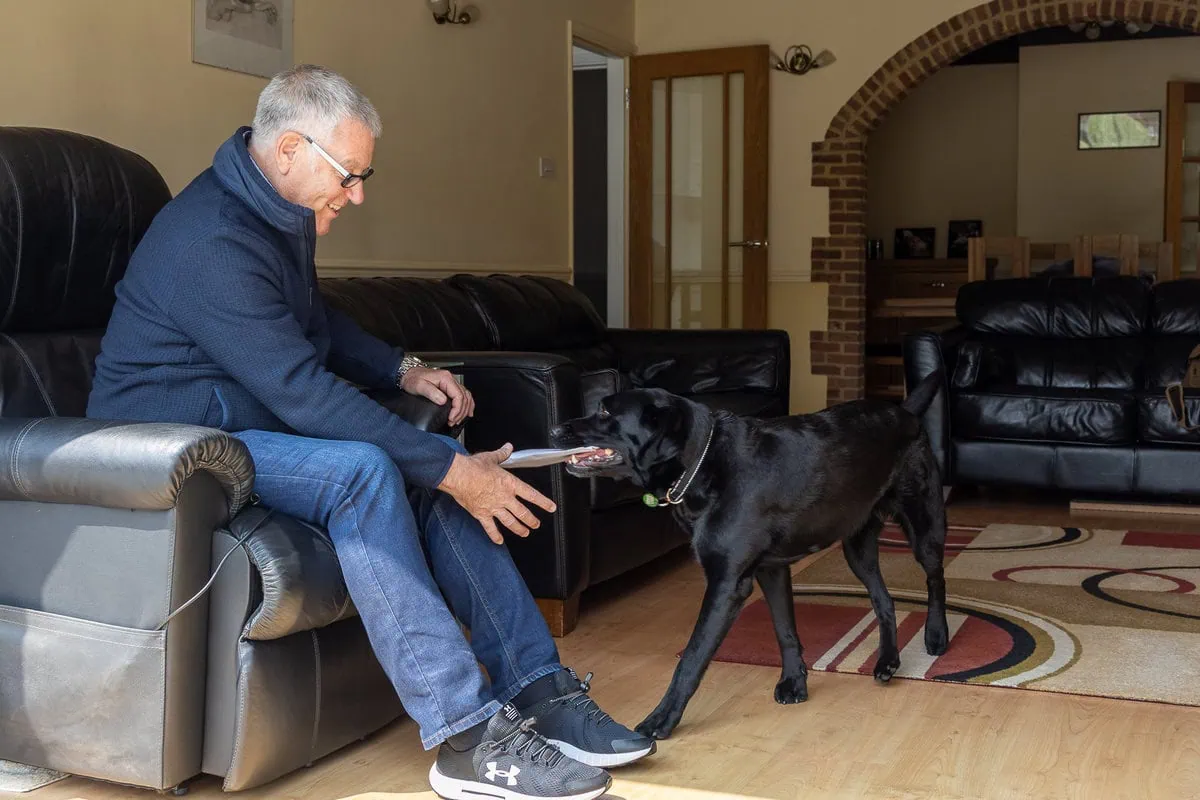
Julia and Georgie have also been helping Carol, who has a dementia diagnosis and was also struggling to engage with physio after a knee replacement in 2023.
Carol’s son, Paul, is her main carer and shared with us some of the powerful outcomes he’s seen through Carol’s connection with the Dogs for Good service and in particular, how Georgie’s particular brand of fun and enthusiasm helps turn chores into fun.
"When my mum was diagnosed with dementia in 2021, we were referred to a local Dementia Wellbeing Service here in Bristol. And from there, we were put in touch with Dogs for Good's Community Dog service," explains Paul.
"Mum's diagnosis wasn't a great shock, there's a family history so, unfortunately, we were expecting it. But it's never a nice bit of news to be given.
"Mum had a knee replacement in 2023 and the recovery from that was quite difficult for her so having some help from the Dogs for Good team, specifically to help her engage with physio, was important as she was finding the motivation a struggle."
One of Carol's main challenges was being able to lift her foot even just a couple of inches over a door threshold. Which meant she didn't go out of the front door. But with Georgie waiting on the other side, the mental block Carol was experiencing was overridden.
"Georgie took mum's mind off the task a little bit and slowly but surely, with practice and repetition it got easier and easier. Then over the course of a few weekly sessions, suddenly, we were out of the house and walking up towards the footpath! It was a remarkable change," says Paul.
"The overriding importance of these sessions for mum are that prior to having them, she was down in the dumps, depressed, didn't want to engage and becoming frustrated with anyone that was trying to help. But as soon as Georgie turns up, that will totally change and she's a completely different person. All of a sudden she's saying 'yep, let's go and do it, let's do it!' and we always see really good improvements following on from the sessions."
One of the standout moments for Paul was when Carol actually managed to achieve the goal they'd both set which was to walk up onto a golf course at the back of the house where a new pond had been put in. Carol also wanted to see a heron which had taken up residence there. "With Georgie by her side, we managed to walk a distance, up the lane, to the pond and the heron was there. Mum hadn't been up there for 25 years or more so it was a real pleasure for her to see the changes, rather than them being described to her. It was an outstanding achievement."
- Carol
Paul says that another benefit of having the Dogs for Good sessions has also been helping his mum with her depression following her diagnosis and then her surgery.
"The sessions really brought her back out of herself, to now being to go out and engage with other activities out of the house such as a dementia friendly allotment that's just up the road. She'll go out of the house, on her scooter and spend time with others in a wonderful outdoor space.
"What makes the Dogs for Good service stand out is Georgie’s infectious enthusiasm which turns what she sees as a chore or hard work, into a fun and pleasurable activity."
Paul says that regular interaction with Georgie has certainly improved his mum's quality of life. "When Georgie turns up, the change in my mum is great. She's always loved dogs and Georgie has an infectious enthusiasm which never fails to lift mum's mood. But importantly, focusing on Georgie, helps mum engage with the activity positively, which helps with her recovery and her general state of mind."
Carol also thinks the service – and Georgie – have been beneficial for her. "Georgie is lovely, she's my cuddle buddy! I think what Dogs for Good offer is fantastic. I've had my own dogs in the past and I love them.
"I miss having dogs so it's lovely when Georgie comes in and makes a fuss of me. I can give her a cuddle, play a few games with her and things. It's so much better than just sitting indoors watching television.
"I feel so much better after I've seen her. She gets me up, gets me out, into the garden and up to the pond to see the birds. I feel better in myself and seeing her gives me something to look forward to."
When Georgie turns up, the change in my mum is great. She's always loved dogs and Georgie has an infectious enthusiasm which never fails to lift mum's mood.
Julia Lange, Georgie's handler, has worked at Dogs for Good for 13 years as a Community Dog Handler.
"A community dog session usually involves me and Georgie, the person we're working with and someone like a healthcare professional or family member, who supports that person," Julia explains.
"Georgie brings lots of different skills. She offers a lot of emotional support to people, she's also great fun and is a very natural motivator. So, a lot of the time when we work with someone who perhaps doesn't want to engage with a session, as soon as Georgie comes along and joins in, it changes everything. She brings a lot to the table."
Our Community Dog programme offers support that is unique to each person or group of people, moving at a pace and level that enables them and our dogs to benefit from time spent together. "It's quite normal for someone to feel nervous when doing something they've not done before, so we go at their pace," Julia explains. "We personalise the sessions, depending on the people involved so they really are designed with the individual in mind. It's very important to us to keep it person-centred, and really, the sessions are just a lovely way to spend time with a dog and explore some new things along the way."
I love seeing the change that Georgie brings to someone's day. Sometimes they're long term and sometimes they're just in the moment but just seeing someone's face light up when Georgie walks in is amazing.
The aims of the Community Dog sessions depend on the person who is being supported. Julia explains: "Some of the sessions will focus on short term goals but a lot of the time we're looking at long term goals such as improving fine motor skills, working on speech and language, sometimes working through things like grief and loss, and reducing social isolation and reintegrating back into the community. We'll also work with a healthcare professional to ensure that all the goals align."
Of course, Julia thinks about the sessions from Georgie's point of view too. "I need to make sure that she enjoys the session, she's happy being in the environment and that I facilitate a nice interaction between her and the person we’re working with," Julia says. "Equally, I want to make sure that the person feels comfortable with Georgie, and they have a really nice time too."
Having a 'natural motivator' like Georgie around makes people a lot more inclined to engage with the sessions. "If someone is perhaps a little reluctant to go for a walk or visit a café, we can put the focus on Georgie and say 'Georgie would really like to go for a walk or visit a new place with you' and that's usually enough for someone to say 'Oh well, if Georgie wants to go, then I would like to go too.'
"Having a dog alongside you breaks down a lot of barriers. Most of us will know if we leave the house and have a dog with us, people will talk to us!"
Lots of Dogs for Good's community-based activities are created in partnership with specialist services such as young people's mental health, social care for adults who have learning disabilities, or dedicated support for people with dementia.
Our Community Dog team works collaboratively with everyone involved in the sessions to measure progress and success. "Working with a healthcare professional, we use a scoring system that's charted pre and post session, so we have everything in numbers. But also, we get verbal feedback from the people we're working with and of course our own observations," Julia explains.
We spend a lot of time with our dogs, like Georgie, so that we can be sure the work they do in the community is both safe and effective. Julia says: "[We teach our] dogs to make sure they're polite, have nice manners etc, and they also must be dogs that naturally enjoy this type of work because not all dogs do.
"We also spend time teaching our dogs specific skills, depending on the activities we're working on. We make sure we have a good structure in place that's safe and enjoyable for all concerned."
Julia says she sees growing demand for services like our Community Dog programme "pretty much everywhere".
"I think we all know someone, somewhere, who would like more support in their lives, whether that's emotional support or even physical support such as helping with physio exercises for example. But I definitely think in terms of mental health and emotional support, there's a huge demand out there."
Emma Gwynne, Bristol-based Community and Engagement Officer at Dogs for Good says: "We know that there are so many more people that could benefit from our services, and our ambition is to increase the amount of support that we offer. How time spent with a dog can help depends on the individual and the goals they want to achieve, and the beauty of the community model is that it enables us to make real tangible differences to lots of people."
"Embedding ourselves within communities will reduce burden on the public services that are so stretched currently and go on to help more people through connection with a dog."
But your support will enable more communities to benefit from the help of our dogs and their handlers.
Holly is a very busy mum of five, fostering children that are neurodiverse as well as children with complex needs, emotional trauma and physical disabilities.
When Victoria’s daughter, Amelie, told her she ‘wished she wasn’t herself’ anymore, it was time to rethink everything.
Style Acre provides person-centred services for 288 adults with learning disabilities and autism across Oxfordshire. The Dogs for Good community dog team supports people there to build life skills for themselves, helping them feel independent, confident and more connected to the world.